Suppose you and I are in a completely dark room, and I am holding a cigarette. When I light the tip, a small glowing point appears. Since the room is pitch-black, you cannot see my hand. If I ask, “What shape do you see now?”

Suppose you and I are in a completely dark room, and I am holding a cigarette. When I light the tip, a small glowing point appears. Since the room is pitch-black, you cannot see my hand. If I ask, “What shape do you see now?” you would naturally say, “I see a red dot.”
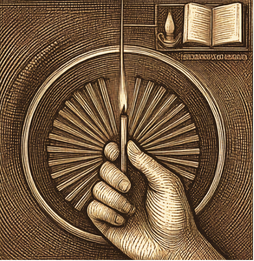
If I tie a string to the cigarette and swing it like a pendulum, and then ask what you see, you would say that you see an arc (a semi-circle). If I then spin it faster and faster in a continuous circular motion, you still cannot see my hand, the person moving it, or the background. You only perceive a continuous shape, which is nothing more than an optical illusion. If I ask what shape you see now, you would say, “I see a circle.”
However, if you recall from geometry, to form an actual circle, I would need to place 360 cigarettes (or points) side by side. But how many cigarettes do I actually hold in my hand? Only one. That is called “Waḥdat al-Wujūd” (the unity of existence).
Bibliography
Muḥyī al-Dīn Ibn al-‘Arabī, al-Futūḥāt, (I-IV), Beirut, no date.
Muḥyī al-Dīn Ibn al-‘Arabī, Rūh al-Quds, Damascus, 1970.
KILIÇ, Mahmut Erol, Şeyh-i Ekber – İbn Arabi Düşüncesi’ne Giriş, Sufi Kitap, İstanbul, 2019.
İbn Arabî|Mahmud Erol KıIıç|Tasavvuf101 video https://youtu.be/6sd9ZsLPLcs?si=iXJIXx_IL7B9GofA