Following our introductory exploration of mythology in the previous issue, we now delve into the dramatic power struggles of the divine realm, beginning with the foundational myth of the Titans.
Following our introductory exploration of mythology in the previous issue, we now delve into the dramatic power struggles of the divine realm, beginning with the foundational myth of the Titans.
Tyranny of Cronos
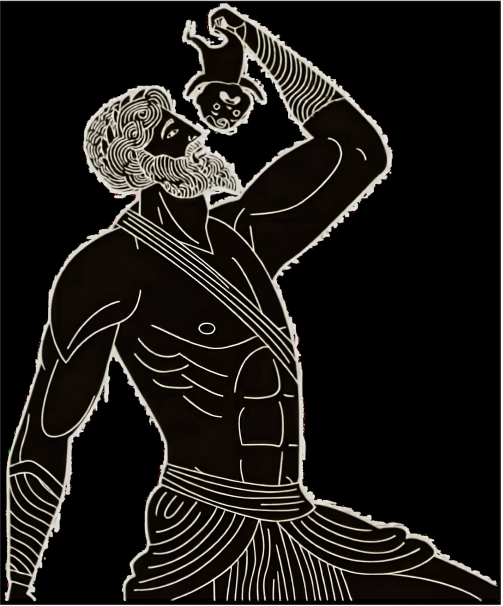
Cronos married his sister Rhea and she became the Queen of the Cosmos. They had six children, but there was a problem: Cronos continuously remembered his father’s prophecy, and feared,“What if these children do the same thing to me? What if my end becomes the same as my father’s?” Then, he committed a desperate act: he swallowed his children one by one. First, his daughters: Hestia, Demeter and Hera. Then, his sons: Hades and Poseidon.
After he swallowed his five children, when his sixth child, Zeus, was born, Rhea decided to protect him child from Cronos. Rhea protected her last child, Zeus, with the help of Uranos and Gaia. They made a plan: Rhea gave Zeus to Gaia, and Gaia brought infant Zeus to the island of Crete, to a cave beneath Mount Ida. Zeus was raised in this cave. Meanwhile, Rhea wrapped astone (the Omphalos Stone) in swaddling clothes to resemble Zeus and gave it to Cronos. Without looking at what it was, Cronos took the stone and swallowed it.
Thus, Zeus was saved, and as time passed, he grew up and went to his father, Cronos, to take revenge. Zeus prepared a drink and gave it to Cronos. Incidentally, Cronos did not recognise his son because he had already supposed that he had swallowed him. After Cronos drank the mixture, he vomited up his children. The siblings of Zeus survived because they were gods and goddesses and had the power of shape-shifting, so Zeus rescued them. After that, he also rescued the Cyclops and Hecatoncheires.
Titanomachy
Continuing the saga of the divine lineage, we now witness the epic confrontation known as the Titanomachy, a war that would ultimately decide the fate of the Cosmos.
There were two sides: The Titans and the Olympians (the Gods). Atlas, the strongest of the Titans and son of Iapetos, was the leader of the Titans in this war. The sons of Iapetos were split: Atlas and Meneoitos supported the Titans, while Epimetheus and Prometheus aligned with the Olympians. The Titans fought from Mount Othrys, attempting to climb Mount Olympos by piling Mount Pelion upon Mount Ossa.
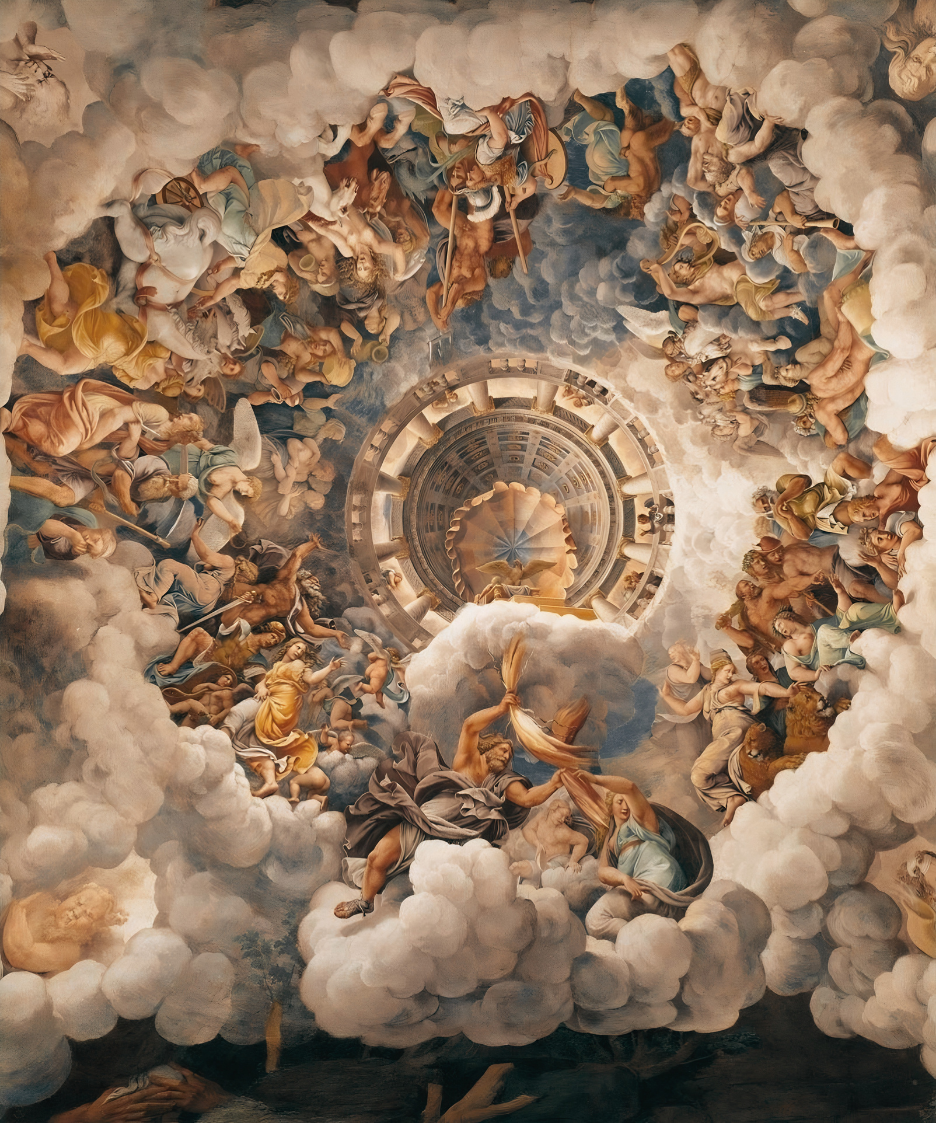
Zeus crushed them with the lightning bolts given to him by the Cyclopes as a gift for rescuing them from the prison where Cronos had held them. Not only Zeus, but also Poseidon and Hades received gifts from the Cyclopes: The Trident was given to Poseidon, and a helmet (which makes the wearer invisible) was given to Hades. Furthermore, Zeus released the Hecatoncheires, who joined the side of the Olympians, providing a great advantage.
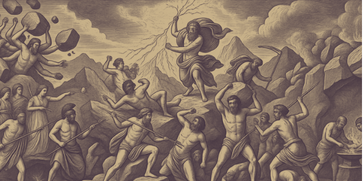
The Hecatoncheires threw hundreds of rocks at the Titans. Since each of the three Hecatoncheires (Cottos, Briareos, and Gyges)had a hundred arms and fifty heads, three hundred rocks rained upon the Titans at once, resembling a literal meteor shower. Zeus empowered the Hecatoncheires with nectar and ambrosia, urging them to demonstrate their unbeatable strength. Cottos gave a loyalty oath to Zeus, and the Hecatoncheires began to fight.
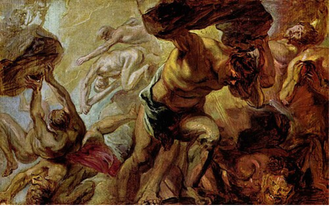
When the clash began, the sea roared, and both the earth and sky shook. Zeus no longer held himself back, hurling his thunderbolts one after another. Fire reached the heavens, and all the chaos was burned with dazzling heat. The Hecatoncheires threw rocks at the Titans and pushed them into Tartaros. Afterwards, Poseidon surrounded Tartaros with bronze gates, and the Hecatoncheires became the loyal guardians of Tartaros.
Then came the punishment of the sons of Iapetos. First, Atlas, as the leader of the Titans, was punished by being forced to hold the pillars of the sky forever. Menoitios was struck by Zeus’s thunderbolts and banished to the dark, deep Tartaros. The other two, Prometheus and Epimetheus, remained without punishment because they had not yet committed any wrongdoing.
The war lasted for ten years and finally ended. Zeus became the king of the gods and the ruler of the Cosmos. Divine missions were shared among the gods and goddesses, and everything seemed peaceful, but there was one more factor. Gaia grew furious because her children, the Titans, were imprisoned. Seeking revenge, she gave birth to Typhon…
Typhon vs Zeus
As Gaia sought revenge for her fallen children, she unleashed her most terrifying creation: Typhon. This final confrontation would decide if the newly established Olympian order could withstand the ultimate primordial threat.
Typhon was the most monstrous, terrible, and enormous creature ever known. As the son of Tartaros and Gaia, he was truly formidable. From his shoulders, hundreds of serpent heads rose; while the upper part of his body looked horrific, the lower part was entirely serpentine. His wings covered his massive body, his arms reached from the west to the east, and his height extended beyond the mountains; his heads even touched the stars.
When he appeared, mountains and seas shook. Because of his fiery breath, the sky was filled with fire. Zeus stood against him without fear and struck him with his thunderbolts. The moment they began to clash, the cosmic order broke, and chaos spread everywhere due to the violence. However, even Typhon could not endure the thunderbolts of Zeus. Zeus scorched and burned Typhon with his divine power. Finally, when Typhon was exhausted and stunned, Zeus cast him down beneath Mount Etna and imprisoned him deep within the mountain. Since then, Etna became a volcano due to the fiery breath of the imprisoned Typhon.
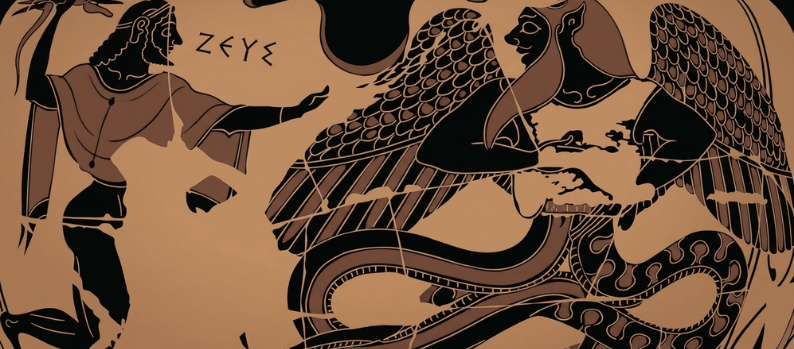
The heads sprouting from his shoulders let out various sounds: sometimes like a god, sometimes like an animal, and sometimes likea hunting howl.
After this struggle came to an end, the gods returned to their own affairs. Zeus, as the king of the gods, assigned them their duties: the seas to Poseidon, the underworld to Hades, and so forth. But to rule alongside him, a queen was needed for the gods…
Marriages of Zeus
Following the establishment of his reign, the king of the gods sought a queen to rule by his side. This pursuit led to a series of divine unions that shaped the celestial hierarchy and the various aspects of the Cosmos.
So, the womanizer Zeus sought a Queen for himself. His first wife was Metis, the goddess of wisdom. Metis became pregnant with the goddess Athena, but aprophecy loomed over them: “Her first child will be agirl, and her second will be a boy who will become greater than his father.” To ensure that he remained the king of the gods, Zeus swallowed his first wife, the wise goddess Metis.
His second wife was Themis, the goddess of divine law. From this marriage, the Horae (Hours) and the Moirai (fates) were born. The Horae set the order of the Cosmos, while the Moirai set the destiny of everything and everyone. The names of the Horae are Eunomia (order), Dike (justice), and Eirene (peace). The names of the Moirai are Klotho, Lachesis, and Atropos.
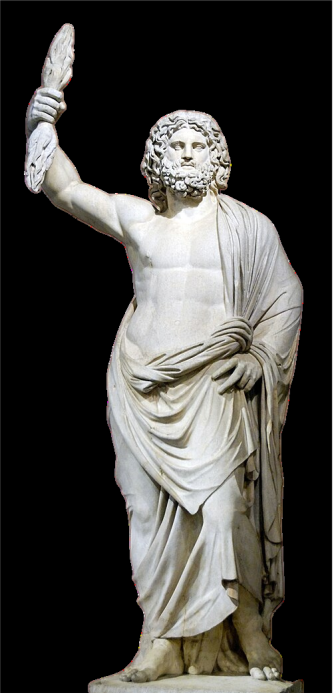
Next, Zeus married Eurynome, the daughter of Oceanus. This union produced the Charites (Graces), the three beauties named Aglaia, Euphrosyne, and Thalia. Afterward, Zeus united with his sister Demeter, and Persephone was born from this marriage.
Then, Zeus lay with Mnemosyne, and the nine Muses were born. These nymphs serve as the sources of inspiration, each presiding over a different field: Calliope, head of the Muses, epic and lyric poetry; Clio, history; Polyhymnia, pantomime; Euterpe, choral poetry; Melpomene, tragedy; Thalia, comedy; Urania, astronomy.
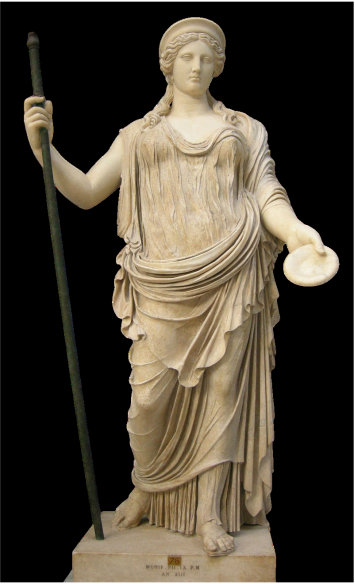
Following this, Zeus and Leto produced Apollo and Artemis. Finally, Hera became the last and permanent wife of Zeus; Hebe, Ares and Eileithyia were born from this final marriage.
The Birth of Athena and the New Olympians
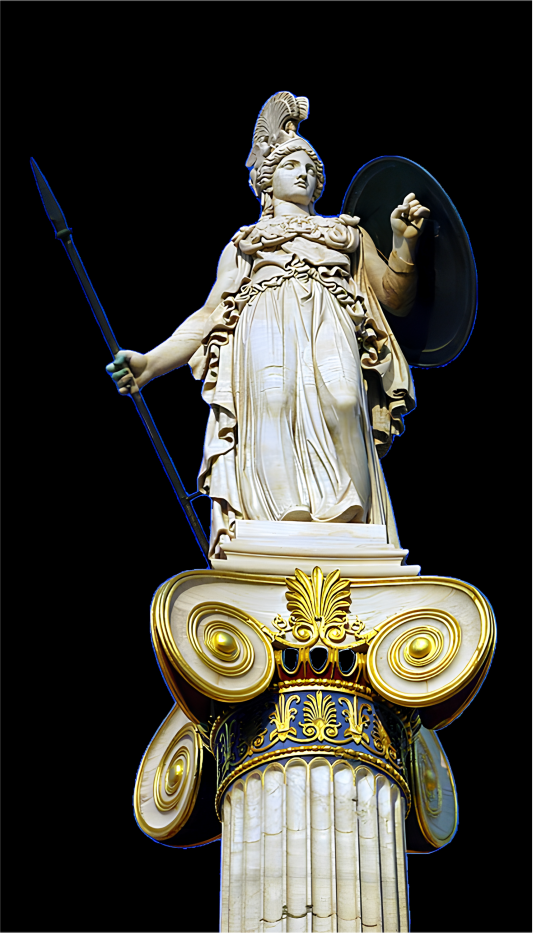
While the reign of Zeus was established through alliances, the birth of his children brought new powers and conflicts to Mount Olympos. When Zeus’s head grew larger and his headaches became unbearable, he ordered his head to be split open with an axe. Once his command was fulfilled, Athena was born from his head, fully armed. Hera, the queen of the gods, witnessed this event and fueled by her anger and jealousy. He decided to give birth to a child of her own withouta partner.
Unfortunately, the result was not at all pleasant. Hephaestus, the blacksmith god, was born from her. When she saw him, she realized he was very ugly; the ugliest among the gods. In her disappointment, she threw her own son from Mount Olympos. After a long fall (as mentioned in the myth, lasting nine days), he landed on the island of Lemnos. Sadly, the fall damaged his leg, leaving him lame for life. Hephaestus grew up on this island as a mighty blacksmith, forging many items for the gods and mortals alike, such as the winged sandals of Hermes.
One day, he crafted a golden throne for his mother, Hera. However, when she sat on it, abooby trap was triggered, and she was locked in. Hephaestus was called to rescue her, but he had conditions: He wanted Aphrodite, the most beautiful goddess, as his wife, and permanent permission to enter Olympos. Once his wishes were granted, he released his mother.
Meanwhile, when Leto became pregnant with Apollo and Artemis, she sought a place where Hera’s wrath could not reach. After Artemis was born, Leto eventually found refuge on the island of Delos, where Apollo was born. Artemis, having witnessed her mother’s suffering, made a vow of chastity and became the goddess of the Hunt, while Apollo became the god of the sun, music, and art. Later, Apollo reached Mt. Parnassos, killed the dragon Python, and established the famous temple at Delphi.
Lastly, we see the birth of Hermes, the son of Maia¹.Almost as soon as he was born, he performed two notable acts: He stole the cattle of Apollo and created the first Lyre from a tortoise shell. He gave the instrument to Apollo, who loved it so much that he forgave Hermes and even gifted him his staff, the caduceus.
To be continued in the next issue: The Story of Humankind…
Bibliography
Can, Şefik. Klasik Yunan Mitolojisi. 22. baskı. stanbul: Ötüken Neşriyat, 2023.
Hesiod. Theogony and Works and Days. M. L. West./Trans. Oxford World’s Classics. Oxford: Oxford University Press, 2008.
¹The month “may” comes from this name