Arabic is undisputedly the common language of the Islamic world and holds an invaluable place in Muslim history. It may seem surprising today, but centuries ago, the paths of a nation and this language crossed in a way that created a magnificent cultural synthesis: Spanish. Although awareness of this interaction remains relatively low in the Islamic world today, fate brought these two languages together at a unique crossroads.
Arabic is undisputedly the common language of the Islamic world and holds an invaluable place in Muslim history. It may seem surprising today, but centuries ago, the paths of a nation and this language crossed in a way that created a magnificent cultural synthesis: Spanish. Although awareness of this interaction remains relatively low in the Islamic world today, fate brought these two languages together at a unique crossroads.
“So, how did this language, arriving like a desert wind, transform into the key to a deeply rooted civilization in the far west of Europe?”
This interaction is the result of a long journey dating back to the Umayyad Caliphate. Our story took root with the conquest of the Iberian Peninsula. Later, the Umayyad prince who escaped the Abbasids founded the Umayyad Emirate of Córdoba, a turning point that would profoundly shape history. From that point on, cultural exchange reached its peak, moving beyond the palace and finding a place among the common people.
This deep interaction was not just a political success, but also an emotional bond. The most touching example of this is found in the life of ‘Abd al-Raḥmān I, the founder of al-Andalus. While conversing with a single palm tree he brought from his homeland in Syria, these verses flowed from his soul, illustrating how Arabic became a ‘language of emotion’ in these lands:
A palm tree stands in the middle of Rusafa, born in the West, far from the land of palms. I said to it: How like me you are, far away and in exile, In long separation from family and friends.”—‘Abd al-Raḥmān I (Menocal, 2002, p. 62)
يا نخلُ أنتِ غريبةٌ مثلي في الغرب
However, this poetic longing would eventually give way to such a profound cultural admiration that the local people would reach the point of forgetting their own mother tongue. The most striking evidence of this transformation was recorded in 854 AD by the Córdoban cleric Paul Alvarus, who lamented the loss of Latin culture:
“The Christians love to read the poems and romances of the Arabs; they study the Arab theologians and philosophers, not to refute them but to form a correct and elegant Arabic. Where is the layman who now reads the Latin commentaries on the Holy Scriptures? Alas! All talented young Christians read and study the Arab books with enthusiasm; they gather immense libraries at great expense; they despise Christian literature as unworthy of attention. They have forgotten their own language. For everyone who can write a letter in Latin, there are a thousand who can express themselves in Arabic with elegance, and write better poems in this language than the Arabs themselves.”
Paul Alvarus, Córdoba (854 AD) (Menocal, 2002, p. 66) —
This lament by Paul Alvarus is the greatest evidence that Arabic had become not a language of “conquest,” but a language of “admiration.” So much so that for every person capable of writing a letter in Latin, a thousand youths were raised who could compete with the Arabs themselves in Arabic poetry.
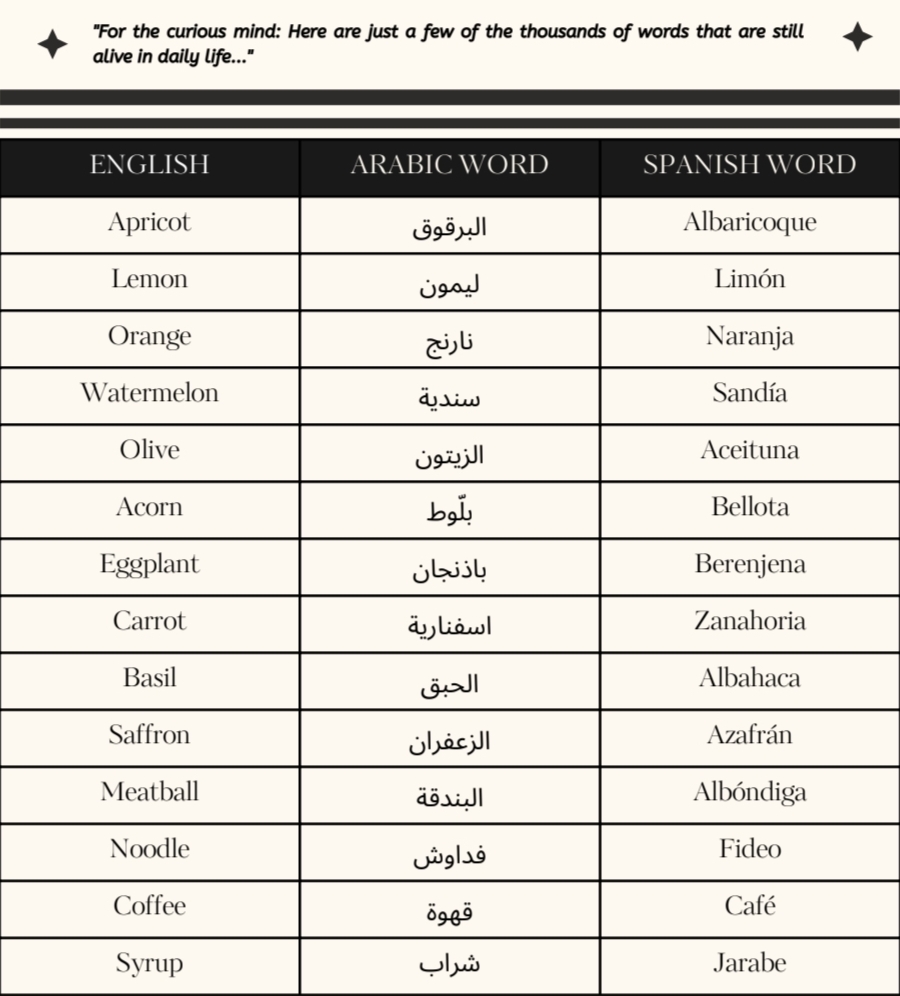
On the other hand, this fascination did not remain merely a literary whim; this deep-rooted cultural interaction descended into the very marrow of the Spanish language, forming nearly 8-10% of the language we know today.
“Now, rather than through an academic discourse, let’s explore this interactive culture through the lens of an ordinary Spanish person’s daily routine.”
A Day in the Life of Dainela
Our character’s name is Dainela. Dainela is a 10-year-old girl living in Spain. She loves playing games, painting, and going to school to learn new things with her friends. Let’s follow her through a typical day:
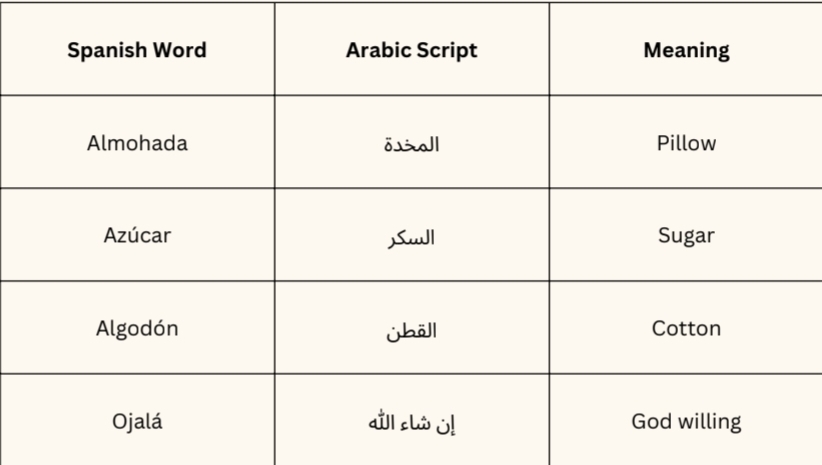
Her day begins in the soft light of morning as she lifts her head from her favorite Almohada. This simple act of waking up on a pillow is her first connection to a thousand-year-old heritage. Shortly after, she heads to the kitchen for breakfast, where she enjoys her morning tea sweetened with Azúcar.
As she prepares for school, she pulls on her uniform made of soft Algodón, perhaps never realizing that the very fabric she wears carries the name given to it by merchants centuries ago. Finally, as she steps out of the house, she whispers a heartfelt hope for the day ahead: “Ojalá!”
As we can see, these words are not merely part of a historical record; they exist in the most ordinary moments of a person’s life. This magnificent bridge between languages, stretching from the courts of Córdoba to a child’s breakfast table, is history’s sweetest and most enduring victory.