Some journeys are not merely about traversing physical distances. At times, they are journeys that build new bridges, revive memories buried in the long-dried pages of history, and bring to life narratives that were never personally witnessed yet faithfully transmitted from the past to the present. The story of the “Hajj on horseback” was precisely such a journey for us—an account that seemed to emerge from the pages of a book written five centuries ago. Indeed, the last Andalusian pilgrims recorded in history, Omar Patún and Muhammad del Corral, set out from the Spanish city of Ávila toward Mecca in the autumn of 1491. Centuries later, this memory became a source of inspiration for others.
Some journeys are not merely about traversing physical distances. At times, they are journeys that build new bridges, revive memories buried in the long-dried pages of history, and bring to life narratives that were never personally witnessed yet faithfully transmitted from the past to the present. The story of the “Hajj on horseback” was precisely such a journey for us—an account that seemed to emerge from the pages of a book written five centuries ago. Indeed, the last Andalusian pilgrims recorded in history, Omar Patún and Muhammad del Corral, set out from the Spanish city of Ávila toward Mecca in the autumn of 1491. Centuries later, this memory became a source of inspiration for others.
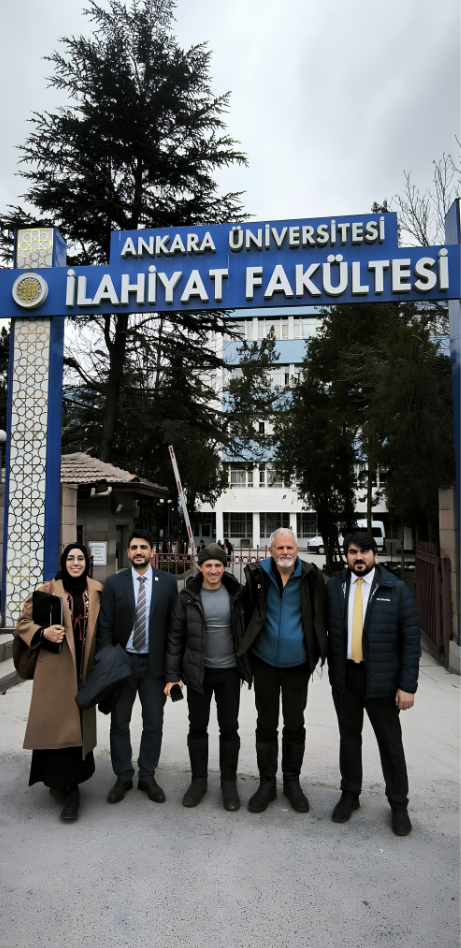
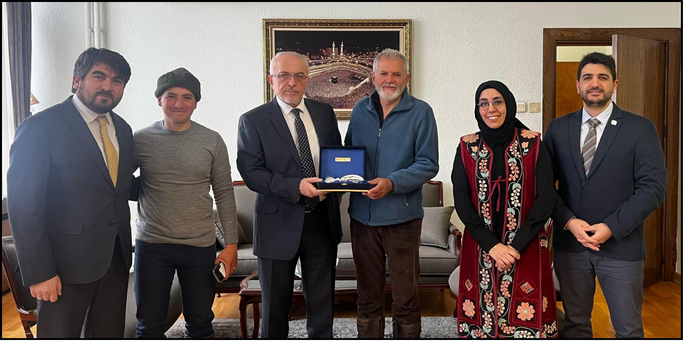
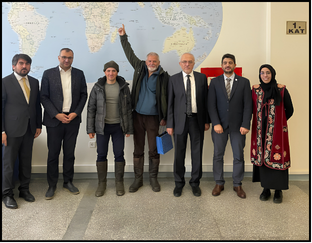
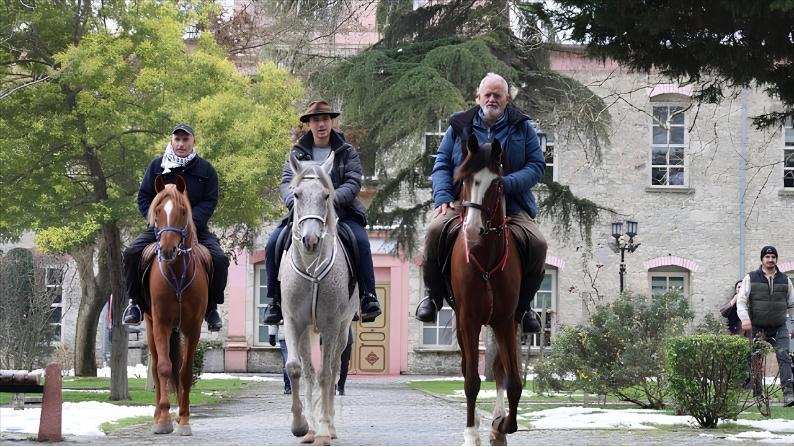
Last year, a group of three men completed their journey, which aimed to revive the horseback pilgrimage of the Muslims of al-Andalus from five hundred years ago and to fulfill the rites of Hajj in the same spirit. Crossing more than eight thousand kilometers and numerous countries, they retraced a path that symbolically connected past and present, al-Andalus and Mecca. Two members of this meaningful journey, Abdullah Hernandez and Abdulkadir Harkassi, visited our faculty during their travels. One of the group members, Abdullah Rafael Hernández Mancha, told us that he first encountered Islam and Muslims at the age of twenty-four. He explained that while studying geography books in preparation for university entrance examinations, he noticed striking correspondences between what he read there and the verses of the Qur’an that came into his hands, a realization that eventually led him to embrace Islam. Through their journey, these Spanish pilgrims brought many forgotten stories back to life. On numerous occasions, all members of the group emphasized their sense of belonging to a heritage rooted in al-Andalus.
Their aim was both to experience a tradition as it had once been lived in its own time and to bear witness, together with all humanity, to a journey that connected time and space. Day by day, we followed their experiences on horseback through social media. As a historian of al-Andalus, witnessing this journey felt like exchanging a direct greeting with al-Andalus itself. Just as people had once set out centuries ago, they too embarked upon the road in the same spirit. Their months-long journey became far more than an effort to reach a destination; in every country, every city, and every new encounter, it transformed into a symbol of goodness and tawḥīd. In many ways, it revived the spirit of al-Andalus for us.
Exactly one year after their journey, we met with them once again as witnesses to this universal and precious experience. We wished to record our testimony. Al-Andalus still breathes—we bear witness to it.
- It has been a year since you completed your 8,000-kilometer journey on horseback. Looking back, how has this experience changed your perspective on life and faith?
Making the Hajj pilgrimage on horseback was the greatest experience of our lives. Nothing has been the same, and nothing will ever be the same again. Some mornings I wake up and wonder if that journey across Europe was a dream or reality. One morning I even jumped out of bed and ran to see if our mares were in the field. Finding they weren’t there confirmed that the journey had been real. Our mares were no longer at home. The hardships of the journey, and the miracles that occured during the most difficult moments, have not only strengthened my faith but also the faith of many who experienced the journey with us. In my daily life, everything has changed. Now I am retired and dedicate myself to my family, playing the oud, and remembering the journey with both longing and pride. I feel that I have fulfilled my obligations in life, that I have kept my promise to Allah, and that I can die peacefully whenever the Almighty calls me. I feel very serene and at peace, like someone who has paid off a great debt.
- You revived a 500-year-old pilgrimage tradition. Now that the vow is fulfilled, what does it mean to you to have successfully connected with this historical legacy?
Having done what our Muslim ancestors did, traveling from Spain to Arabia, reminded us of the difficulties they, too, must have faced. In many places, we have looked at landscapes, mountains, and even caravanserais where they must have traveled, and stayed. It is like going back in time and coming face to face with our ancestors. A unique experience.
- As modern-day Muslims from Spain, how do you define the spirit of al-Andalus in the 21st century?
The spirit of Al-Andalus is still very much alive in 21st-century Spain. It is an eight-century period in our history that has left an indelible mark on monuments, language, customs, folklore—flamenco is a prime example—and culture in general. Some try to denigrate this period, while others consider it a flourishing period of medieval culture. We are undoubtedly the children and heirs of al-Andalus, and we continually reclaim this heritage.
- The history of the Moriscos is a story of resilience. During your journey, did you feel like you were retracing their steps and carrying their silent prayers to the Holy Lands?
The Moriscos were the Spanish Muslims forced into Christian baptism, but who continued to secretly practice their Islamic faith. Almost all Spaniards are descendants of Moriscos. Proclaiming our Islamic faith, bringing it into the open, is both an obligation and a tribute to our ancestors.
- How important is it for the young generation of Muslims in Spain to learn about their roots in al-Andalus and Morisco history?
Remembering al-Andalus is very important. Among young Spanish Muslims, al-Andalus is very present, and its history is very much alive. This is not always the case within institutions, as we cannot forget that, although Spain is a secular country, the majority of the population is Catholic.
- You passed through many countries and met people from different backgrounds. What was the most common reaction you received when people saw “pilgrims on horseback”?
When we had barely covered a few hundred kilometers, still in Spain, people were already amazed by our journey. When our horses were in Italy, Bosnia, and Turkey, people came out to see us, to take pictures with us, to offer us gifts and money. The welcome has been truly wonderful.
- Throughout the entire 8,000 kilometers, if you had to name the “most emotional moment,” which one would it be?
Obviously, the most emotional moment of the trip was seeing the Kaaba in Mecca. Thinking every day when we prayed about how far away it still was, but then, when the moment arrived, entering the Haram of Mecca and touching the wall of the Kaaba was a once-in-a-lifetime experience.
- What are the current opportunities and challenges for the Islamic community in Spain today?
The advantages lie in the fact that Spain is a country with religious freedom. Our marriages and relationships are accepted by the State and have legal validity. However, local councils often create difficulties for two things: the construction of mosques and Islamic cemeteries. In Europe, there is an increasing presence of Islamophobic far-right elements, often clearly and demonstrably financed by Israel.
- How does the legacy of al-Andalus contribute to the dialogue between Muslims and the wider Spanish society?
It is paradoxical that the Islamophobic far-right leader Santiago Abascal is heir to al-Andalus even in his surname and physical appearance. That says it all. Fortunately, this is not always the case, and there are, for example, publishing houses that publish many books and research works on al-Andalus. There are also music competitions and cultural programs about the memory of al-Andalus aimed at the general public.
- During your stay in Türkiye, what impressed you the most about the Turkish hospitality and the local Islamic culture?
Türkiye has been an essential part of our trip. The first day we rode horses in Türkiye coincided with the first day of Ramadan. Every day, we received breakfast and lunch to break our fast from neighbors, town halls, institutions, or even the Turkish police. It was very moving to ride horses without knowing where or how we were going to eat, but not a single day did we lack food, and not a single day did we have to cook. They hosted us in their homes, in spas, and in beautiful places. We will always remain grateful to Türkiye and this gratitude can be summed up in one sentence: We love Türkiye! And we will return every time we have the opportunity to do so.
- What profound message does the legacy of al-Andalus hold for the modern world and the global Muslim community today?
I believe there are many hidden messages in the history of al-Andalus. The first of them is that division, confrontation, and civil war cause the weakness that our enemies exploit to destroy us. Al-Andalus was a light of science, wealth, prosperity, monuments, and happiness, but the confrontations between brothers, between cities and peoples, weakened them to the point that the “lousy” Christian kingdoms of the north conquered and destroyed them.
- In your opinion, how should we approach and truly understand this unique period of history?
Al-Andalus also teaches us the importance of education and knowledge for Muslims. Al-Andalus was a continuation of “human civilization.” It took science and knowledge from the classical Roman, Greek, and Byzantine worlds and transmitted them to Europe, which was then able to develop the Renaissance and eventually discover America. In al-Andalus, science grew; without al-Andalus, the Renaissance would not have existed in Europe.
- What is your final message to the theology students who are reading this interview and may wish to embark on their own spiritual journeys?
My personal message to theology students is that Islam is the pinnacle of human development; it is the highest point humanity can reach. But to understand it in its true dimension, one must know the natural sciences, Creation itself. I especially recommend studying Ibn Rushd, who personally influenced me greatly and encouraged me to study and pray, which, in short, are the same thing because they allow us to see the greatness of Allah’s Creation.